Districts want to highlight retirees’ costs
This graph, which does not include the latest rate of return on investment or scheduled increases in contributions rates, shows the volatility in CalSTRS' earnings over the past decade. Benefits payments increased while contributions from employers and employees declined, reflecting staffing cuts during the recession.
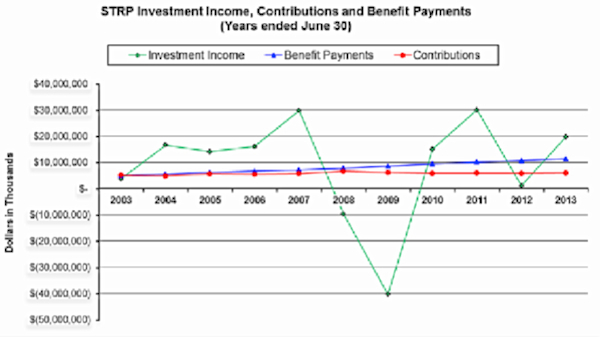
This graph, which does not include the latest rate of return on investment or scheduled increases in contributions rates, shows the volatility in CalSTRS' earnings over the past decade. Benefits payments increased while contributions from employers and employees declined, reflecting staffing cuts during the recession.
A coalition of schoolhouse districts wants Gov. Jerry Brown and the Legislature to clarify how much coin will be bachelor to schools following the deal that legislators struck earlier this yr requiring districts to make higher pension payments.
The coalition isn't asking for the state to pick up a bigger share of the expense, recognizing that won't happen. Instead, it wants the Legislature to distinguish retirement costs that districts must pay from the residuum of the general funding that districts receive under Proposition 98, the formula that determines how much coin 1000-12 schools are entitled to. The issue would be to shrink the corporeality that districts get from the Local Control Funding Formula while sending a clear bulletin to temper the public's and staff's expectations: At that place'd be more than money to become around, were it not for escalating retirement expenses.
"Nosotros are seeking a different funding method to deal with the extraordinary cost to bring security to the retirements of school employees and to bring transparency" to the Local Control Funding Formula, board members of the CalSTRS Funding Coalition wrote in an article last week announcing its formation. It was published on the website of California School Services, a school consulting and lobbying firm that said information technology supports the new effort. The iv-district coalition, which expects to abound, includes Los Angeles Unified, the state's largest school commune.

Credit: John C. Osborn/EdSource Today
All three contributors to retirement benefits for teachers – teachers themselves, the state and schoolhouse districts – will pay more under the legislation approved this twelvemonth. Districts volition blot lxx percentage of the increment, rising from several hundred 1000000 dollars this year to nearly $three.seven billion annually in 2020-21.
In June, Brown proposed and the Legislature adopted substantial increases in contributions to the California Country Teachers' Retirement Organisation. Teachers, the country and districts will pay increasing amounts over 7 years. The higher rates will bring the alimony program to full funding in 30 years, wiping out a $74 billion deficit acquired by plummeting stock values and investment returns in the 2008 recession.
Total almanac contributions will double by 2020-21 and then go on, with school districts bearing nearly 70 per centum of the $v.two billion increment. The coalition said that CalSTRS costs will ascent from 3.viii percent of an average district's budget to 9 pct over that time. That increment will cut into coin the Legislature anticipated districts would spend every bit funding was restored to pre-recession levels. Under the new funding formula, districts are also planning to spend more as they expand programs for "high-needs" students, including low-income students and English learners.
The state's share of pension costs, though smaller, volition besides double, and teachers' contributions, deducted from their paychecks, will rise past about a quarter, from viii percent of their pay to 10.25 percent.
The coalition is request that districts' retirement charges be a separate account within Proffer 98. Districts currently have to make room for retirement costs inside the Local Control Funding Formula. Since retirement costs aren't discretionary, they shouldn't be role of the formula, the coalition argues.
"If it had been a one-time increase, we would be fine, but it will continue to abound for six more years," said Scott Siegel, superintendent of Ceres Unified.
When it passed the new funding system in June 2013, the Legislature set the goal of restoring funding for all districts to 2007-08 levels within seven years while providing boosted money for high-needs students. Only that was a year before lawmakers passed the plan for rescuing the CalSTRS retirement programme. Setting money bated for CalSTRS obligations would delay reaching the funding goal, though the coalition didn't judge by how long.
The betoken, said Scott Patterson, deputy superintendent of business services for the Grossmont Marriage High Schoolhouse District and a coalition board member, would be "communicating to parents and staff that the state is non going to reach the target of getting dorsum to 2007-08 levels as soon equally they would like to."
"For all stakeholder groups, at that place'd be a articulate picture of new money coming to districts – how much parents tin can expect for targeted funds for students and how much is bachelor for teachers to negotiate pay and benefits," said Scott Siegel, superintendent of Ceres Unified School District. For his 12,000-student district, college CalSTRS expenses will cost an additional $1 1000000 annually out of a $100 meg upkeep.
"If information technology had been a i-time increase, we would be fine, but information technology will keep to abound for vi more years," he said.
Desert Sands Unified is too part of the coalition, along with Los Angeles Unified, Ceres and Grossmont. Patterson said he expects the coalition to grow to 150 to 200 districts – whichever are willing to underwrite the lobbying effort. He said that the coalition has not yet presented its idea to officials from the Department of Finance, which prepares Brown's budget, or to legislative leaders.
"I tin't think of why a district would not be in favor of this," Patterson said.
H.D. Palmer, spokesman for the Department of Finance, declined to comment on the proposal, awaiting the release of Chocolate-brown's proposed state upkeep in January.
To get more reports similar this one, click here to sign up for EdSource'southward no-toll daily e-mail on latest developments in teaching.
Source: https://edsource.org/2014/districts-want-to-highlight-retirees-costs/71343
0 Response to "Districts want to highlight retirees’ costs"
Post a Comment