Big Red Writes Again Ads Big Red Pen Advertisement
 | parkerpens.cyberspace |
| PARKERCOLLECTOR.COM |
 Please donate to help me keep this site online. Please donate to help me keep this site online. |
| |
| Pens for sale |
| Selected stores |
| 10 Fountain pen tips |
| Pen repairs |
| Parker Pen catalogue |
| Interview: M Hollington |
| Feature: Parker Archives |
| Parker Technical Sectionalisation |
| Web-Idiot box |
| Metric converter |
| Date codes and other |
| Inquire Tony |
| Contact |
| Join newsletter |
| Nearly me |
| Donate |
| FPN Forum (link) |
| Vacumatic Guide |
| Montblanc Guide (erstwhile) |
| The Penography: |
| * = images pending |
 Which model is my pen? Which model is my pen? |
| Parker 15 |
| Parker 17 |
| Parker nineteen |
| Parker 21 |
| Parker 25 |
| Parker iii-in-1 |
| Parker 35 |
| Parker 41 |
| Parker 45 |
| Parker l |
| Parker 51 |
| Parker 61 |
| Parker 65 |
| Parker 71 |
| Parker 75 |
| Parker 85 |
| Parker 88 |
| Parker 95 |
| Parker 100 |
| Parker 105 |
| Parker 180 |
| Eversharp x.000 |
| Parker Arrow |
| Awanyu "Aztek" |
| Parker B5 |
| Parker Large Arrow |
| Eversharp Large E |
| Parker Large Reddish |
| Parker Black&Gold |
| Parker Black Giant |
| Bookkeepers Special |
| Bulldog Special |
| Parker "Bullet" Pen |
| Parker Centennial |
| Parker Challenger |
| Eversharp Challenger |
| Parker Archetype |
| Parker Higher pen |
| Parker Contact |
| Parker Debutante •• |
| Eversharp DeLuxe |
| Parker Desk Sets •• |
| Parker Dimonite |
| Parker Dip Pen |
| Parker Dollar Pen |
| Eversharp Doric |
| Parker DQ |
| Parker Duette |
| Parker Duofold |
| Parker UK Duofold |
| Parker Duo-Tone |
| Parker Duovac |
| Parker Ellipse |
| Parker Emblem Pen |
| Parker Esprit |
| Parker Executive |
| Parker Eyedropper |
| Parker Facet |
| Parker Falcon |
| Parker Filigree |
| Parker FP-1 |
| Parker Frontier |
| Parker Galalith |
| Eversharp Gamin |
| Parker Geometric |
| Parker Golden Arrow |
| Parker Hopalong Cassidy |
| Parker Royal •• |
| Parker I.M. |
| Parker Inflection |
| Parker Insignia |
| Parker Itala |
| Parker Ivorine |
| Parker Jack Knife |
| Parker Jointless |
| Parker Jotter |
| Parker Lady |
| Parker La Plumage |
| Parker Latitude |
| Parker Liquid Lead |
| Limited Edition |
| Parker Lucky Bend |
| Parker Mercur |
| Parker Minibille |
| Parker Minim |
| Parker Mixy |
| Parker Moderne |
| Parker Multy |
| Ms Parker |
| Parker Parco |
| Parker Parkette |
| Parker Pastel |
| Parker Patrician |
| Eversharp Point *seven |
| Parker Popular |
| Parker Pre-Duofolds |
| Parker "Pregnant" |
| Parker Premier MK I |
| Parker Premier MK 2 |
| Parker Profile |
| Parker Raven |
| Parker RB-1 |
| Parker Crimson Giant |
| Parker Reflex |
| Parker Rialto |
| Parker Shorthand |
| Parker Silver Dollar |
| Parker Slimfold |
| Parker "Ophidian" |
| Parker "Swastika" |
| Slinger/Swinger •• |
| Parker Special • |
| Parker Sonnet |
| Parker Systemark • |
| Parker T1 |
| Eversharp Teena |
| Parker Televisor |
| Eversharp Tiara |
| Eversharp Tip Wic |
| Parker Touché •• |
| Parker Trench Pen |
| Parker Truthful Blue •• |
| Parker Urban |
| Parker Vacumatic • |
| Parker Vacuum Filler |
| Parker Valentine • |
| Parker Varsity |
| Parker Vector • |
| Parker Victory |
| Eversharp Victory |
| Parker VP |
| Parker VS |
| Parker Writefine |
| Parker X |
| Parker 40 |
| Parker Zephyr |
| |
Acknowledgements |

| | ||
 enneth Parker knew that many left handed people had trouble with fountain pens. He even had a large silverish desk-bound base fabricated for Dwight D. Eisenhower that held two "51" pens, and that had special ground nibs; one correct-handed and one left-handed. The problem was that unless a left-handed person held the pen in an akward position they would drag the hand through the wet ink while writing. enneth Parker knew that many left handed people had trouble with fountain pens. He even had a large silverish desk-bound base fabricated for Dwight D. Eisenhower that held two "51" pens, and that had special ground nibs; one correct-handed and one left-handed. The problem was that unless a left-handed person held the pen in an akward position they would drag the hand through the wet ink while writing. Furthermore it was expensive and time-consuming to repair the Parker "51" and Parker "61" that were Parkers best selling pens at that time. Some customers also wanted special nibs. Collectors of Parker "51" know how hard information technology is to observe extra broad nibs on these pens. Most pens needed to be sent back to the manufacturing plant to be refitted with the customised nibs. Kenneth Parker was playing effectually with an idea of a pen with an adjustable grip, which would brand life a little easier for left-handed writers, and others that preferred a somewhat different writing angle. Only this would hateful a removable nib unit of measurement. At the same time the injection molding techniques were beingness refined and Fred Wittnebert, who was the caput of Parkers technical sectionalization, and among other things had invented the capillary filler for the Parker "61", was working on a program to design a modular pen. This would allow parts to fit many different kind of models, which would cut downwardly on the production costs. |  he solution was a neb/feed-unit that could be unscrewed and easily replaced. The ideas developed over fourth dimension into the famed Parker "45". The patents showing the Parker "45" nib, collector and the converter was filed in 1960 and states Homer Ted Dark-green as the inventor. He was also the man backside the T1's integrated nib. However, the new neb-unit of measurement that would solve the angle-problem had to look a few years until the introduction of the Parker "VP", and later the Parker "75", simply the easily replacable nibs proved a good idea. Nevertheless the route to the finished pen was long and winding. he solution was a neb/feed-unit that could be unscrewed and easily replaced. The ideas developed over fourth dimension into the famed Parker "45". The patents showing the Parker "45" nib, collector and the converter was filed in 1960 and states Homer Ted Dark-green as the inventor. He was also the man backside the T1's integrated nib. However, the new neb-unit of measurement that would solve the angle-problem had to look a few years until the introduction of the Parker "VP", and later the Parker "75", simply the easily replacable nibs proved a good idea. Nevertheless the route to the finished pen was long and winding. The razor king King Camp Gilette once worked at a bottle cork seal factory and his boss at once told him that the hugger-mugger of success was to produce something that people used a few times and then threw away. Well, while Gillette got his idea one morning shaving, Parker likewise realised that a cartridge filler for fountain pens would be economically sound. Parker had put an incredible lot of coin and thought into developing new filling systems, first the Button filler, and so the Vacumatic filler, the Aerometric filler and and so the Capillary filler, and was at kickoff hesitant to convert to not integrated filling systems of their own. They had also had a short lived experiment with a cigarette lighter chosen the Parker Flaminaire (1950-1952) that independent a replacable cartridge of liquid lighter fluid. Unfortunately these cartridges could not hands exist refilled, which before long rendered the discontinued lighter useless. Parker had many complaints from dissatisfied customers that had paid proficient money for a lighter that would no longer piece of work. | |


| |
| 1943 advertizement. |
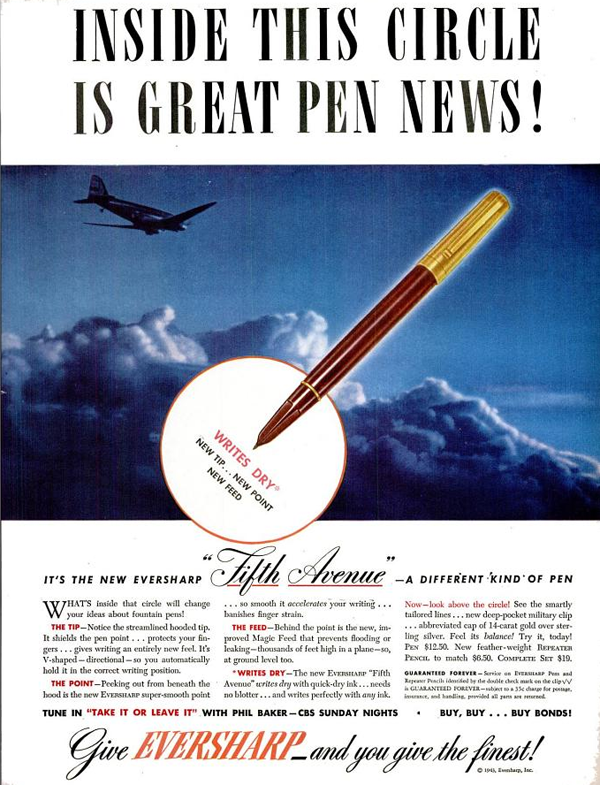
 canning the competitors, Parker realised that the cartridge filler that worked all-time was patented and made by the Wahl-Eversharp company for their CA brawl pens. canning the competitors, Parker realised that the cartridge filler that worked all-time was patented and made by the Wahl-Eversharp company for their CA brawl pens.The Parker-Eversharp story really started with a patent infringement. After Argentina-based Lászlo Jozsef Biró patented the first functional ball pen back in 1941, the Usa pen company Wahl-Eversharp decided that they wanted to get on that train. They had just launched their highly acclaimed Skyline model, designed past Henry Dreyfuss, simply the company needed to notice new markets to stay afloat, especially in the light of Parker'southward unprecedented success with the Parker "51". Wahl-Eversharp tried their own version of a fountain pen with a hooded beak, the 5th Avenue, which was introduced in 1943. It was fifty-fifty advertised with an aeroplane, similar the early on Parker "51" ads! Wahl-Eversharp also decided to secure the rights for the ballpens for the American market place and in May of 1945 they did indeed buy the rights from Biro's visitor and adult a brawl pen nether the Eversharp proper name. They spent a staggering two million dollars on this venture. Eversharp released a prototype ballpoint pen to journalists already in May of 1945. |  owever, before they had a hazard to launch their new pen they were astounded to come across that an American businessman from Chicago, Milton Reynolds, began selling his own brawl pen, Reynolds Rocket, based on Birò's patent, through the section stores of Gimble. This took identify in October, earlier Eversharp's official release. Reynolds had actually flown to Buenos Aires to become concur of the Birò patent, but to no avail. This didn't discourage him from producing his ain pen. He launched a massive advertising entrada and Eversharp couldn't stop him from eventually selling millions of ball pens. Of course a legal boxing followed and Eversharp had no other choice than to launch their ain pen, the "CA", fifty-fifty though it hadn't however been fully tested. owever, before they had a hazard to launch their new pen they were astounded to come across that an American businessman from Chicago, Milton Reynolds, began selling his own brawl pen, Reynolds Rocket, based on Birò's patent, through the section stores of Gimble. This took identify in October, earlier Eversharp's official release. Reynolds had actually flown to Buenos Aires to become concur of the Birò patent, but to no avail. This didn't discourage him from producing his ain pen. He launched a massive advertising entrada and Eversharp couldn't stop him from eventually selling millions of ball pens. Of course a legal boxing followed and Eversharp had no other choice than to launch their ain pen, the "CA", fifty-fifty though it hadn't however been fully tested. Eversharp launched the CA belatedly in Apr 1946 following an unprecedented concentration of ads. In New York lone Eversharp bought ten full pages on a single day. This was of course a strategy to make upward for time lost. The beginning "CA" brawl pens, which stood for Capillary Action, were designed like the Skyline fountain pens and they utilised another novelty, a cartridge filler. When information technology turned out that the Reynold ball pen was a poor production, the demand for ball pens chop-chop diminished, and when Eversharp too realised that the CA was a defective product the company was in severe problem. Eversharp had sold the CA with a lifetime guarantee and when honouring this, they fabricated a loss of $iii million on returns lone. They were going bankrupt, and fast. Furthermore information technology turned out that the slow drying ink made it possible for forgers to elevator signatures from one document and stamp it on another, creating a perfect forgery. |
| |
| 1946 ads. |
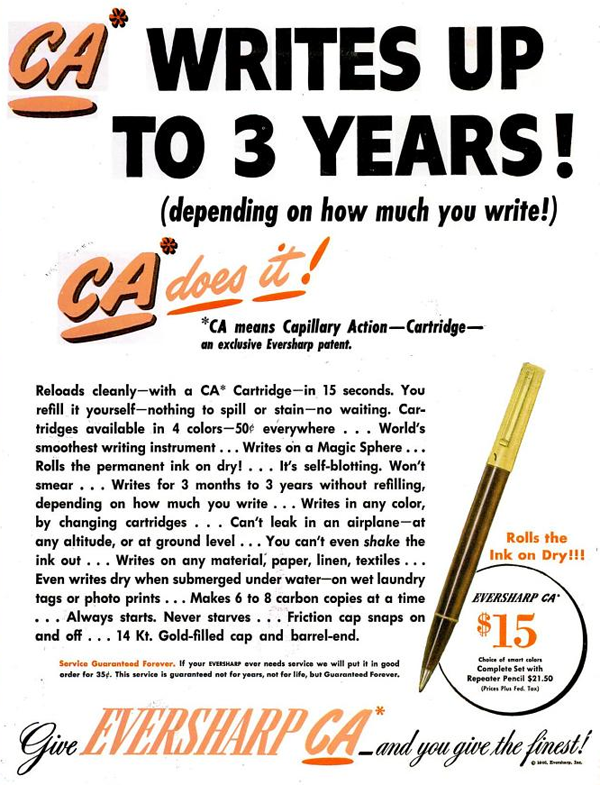
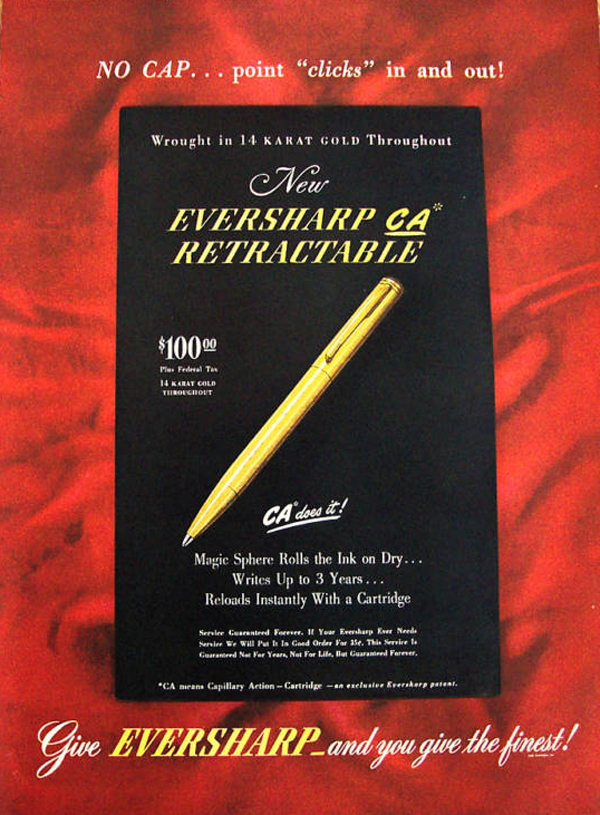
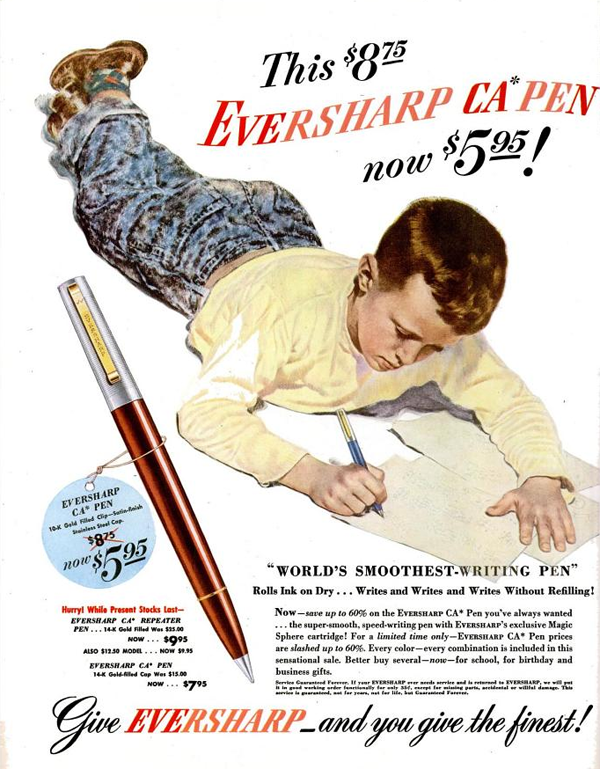
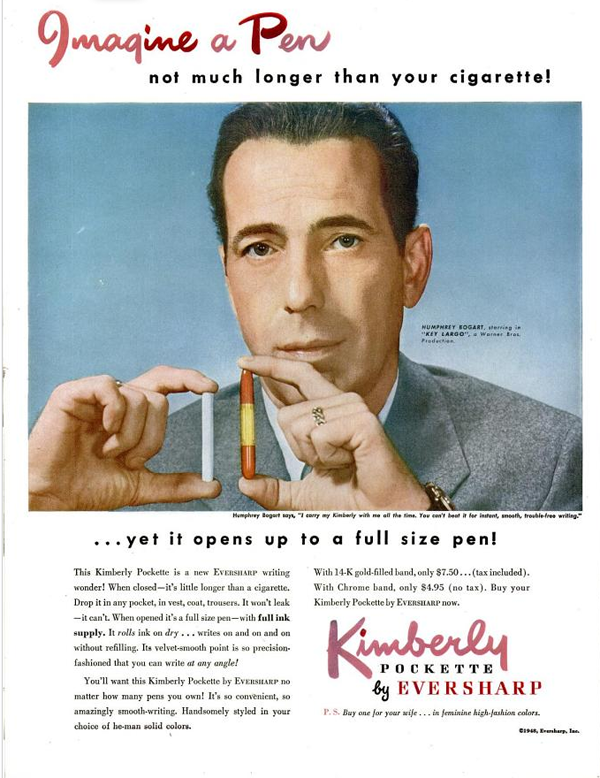
 versharp likewise manufactured the CA for the Fifth Artery line, but this line proved unsuccessful, mainly becuse the pattern prevented a reasonable ink-supply for the fountain pens, and the pens were discontinued already in 1946. The same year a retractable CA was introduced without a cap. Initially the CA price $fifteen, in March of 1947 the cost was down to $8.75, in October it was down again to $vi.75 and eventually it striking rock lesser at $5.95. Eversharp so decided that the proper noun "CA" was so stained that it was removed from all advertizement. In 1948 the pen was renamed the Super-sphere and priced at $7.95, "made to sell for $15". versharp likewise manufactured the CA for the Fifth Artery line, but this line proved unsuccessful, mainly becuse the pattern prevented a reasonable ink-supply for the fountain pens, and the pens were discontinued already in 1946. The same year a retractable CA was introduced without a cap. Initially the CA price $fifteen, in March of 1947 the cost was down to $8.75, in October it was down again to $vi.75 and eventually it striking rock lesser at $5.95. Eversharp so decided that the proper noun "CA" was so stained that it was removed from all advertizement. In 1948 the pen was renamed the Super-sphere and priced at $7.95, "made to sell for $15". Eversharp decided to try to repeat the success with the Skyline, by hiring the industrial designer Raymond Loewy, perhaps most famous for designing the logos for Shell and Lucky Strike, the Greyhound bus and also for a redesign of the Coca Cola bottle. The Skyline model was discontinued in 1948 to make fashion for the new pen. Almost a parenthesis, the Kimberly pen company was a Los Angeles based ball pen manufacturer that Eversharp had sued for two 1000000 dollars for patent infringements around 1945. Eversharp eventually ended up buying Kimberly in 1947 dismissing it's activity against the visitor, and, in 1948, the The Kimberly Pockette was introduced, a very small ball pen that turned into a regular size when the cap was posted. Later likewise regular size Kimberly Eversharps were offered. The Super-sphere-proper noun was replaced past the more than prosaic Reporter the same year. |  ight earlier christmas in 1948 the Eversharp Symphony was introduced with a metal cap. They were plastic pens with chrome caps and gold trim, nicknamed "slipper caps" on account of the pens having a "seam" effectually the rim. The offset model was referred to as the 500 and was offered in the colours of Black, Ruby-red, Blue and Green. By December the second generation of Symphony was introduced, and came in three different designs, the 701 Standard with a narrow cap band, the 703 Deluxe, which had a wide cap band and the 705 Gilded Symphony, with a gold filled cap. The colour range was also enhanced. Furthermore an economy model, strangely advertised as the 707 Luxury, was also introduced. Information technology was very like to the "705", only distincly smaller. ight earlier christmas in 1948 the Eversharp Symphony was introduced with a metal cap. They were plastic pens with chrome caps and gold trim, nicknamed "slipper caps" on account of the pens having a "seam" effectually the rim. The offset model was referred to as the 500 and was offered in the colours of Black, Ruby-red, Blue and Green. By December the second generation of Symphony was introduced, and came in three different designs, the 701 Standard with a narrow cap band, the 703 Deluxe, which had a wide cap band and the 705 Gilded Symphony, with a gold filled cap. The colour range was also enhanced. Furthermore an economy model, strangely advertised as the 707 Luxury, was also introduced. Information technology was very like to the "705", only distincly smaller. Although bonny, the Symphony line lacked the innovative features of Eversharp's competitors. It had a standard open nib, information technology had a lever filler, and information technology wasn't actually all that sexy. Brawl pens were of grade offered in the Symphony blueprint, but the brawl pen market place was now standing on clay feet. Parker sneaked out a ball pen of their own in 1950. Information technology was made by their depression cease Parkette section and featured the head of the movie star |
| |
| 1947 ad and the Parker Hopalong Cassidy ball pen. |
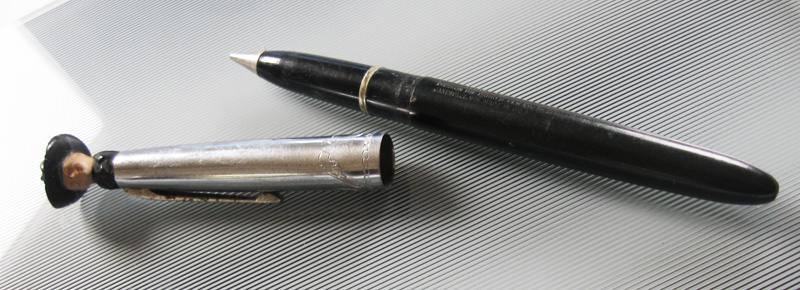
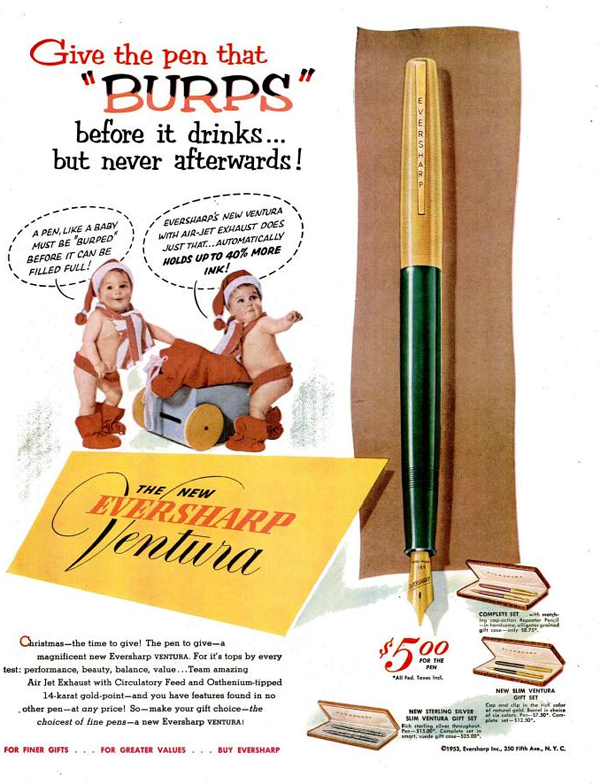
| he Eversharp Symphony was redesigned a third time in 1951, most likely to cut production costs. These MKIII Symphonies had a simplified cap, nicknamed the "bullet cap". The 707 was discontinued, also around 1951, and was replaced by an all plastic version, introduced in 1952. The redesign evidently didn't testify much of a success, since the Symphony line was phased out in 1953, to be replaced past the bulb-filler Ventura "Burp" line. It had a metal, more cylindrical cap than the Symphony line and sported a foursquare clip. The filler was similar to the Parker "51" Aerometric filler only lacked the quality and finesse. Information technology was heavily advertised as the pen that "Burps" and was offered in the vi colours of Black, Navy blueish, Grey, Light-green, Brown and Burgundy. There were likewise all-metal models offered. The Ventura was to be the last of the Wahl-Everharps. The endevour to get Americas prime brawl pen manufacturer was definitely crushed in 1954. Parker had seemed reluctant to make brawl pens and this was so strange that Time Magazine in 1946 had an editorial where they contemplated why Parker was napping in the midst of the ball pen boom. This led Kenneth Parker to make a statement in a letter to the magazine that he resented all such nonsense. Kenneth Parker had learnt from his piece of work with the Duofold, the Vacumatic and the Parker "51" how important information technology was to be really creative and innovative. Merely past offering a truly great product would one be able to stay in business concern. | ight when it was thought that the concept of ball pens was dead, Parker, who had rushed slowly in the middle of the ball pen hysteria, in 1954, afterward nine years of research, presented their ain version of the brawl pen, the Jotter. In functionality information technology far exceeded everything produced until then. Information technology differed in several aspects from Birós, Reynolds and Eversharps pens: it wrote five times as long, information technology was easy to refill and information technology came with a choice of beak sizes. And information technology worked. Parker sold 3.5 1000000 Jotters the get-go twelvemonth of production and the year 1954 marks the definite turning signal when the ball pen exceeded the fountain pen in sales in Europe and the US. Every bit for Eversharp the company was at present virtually bankrupt, and in 1957 the pen-division was for sale. This fitted Parker'south plans. While the Wahl-Eversharp razor division remained, by January i, 1958, Parker had caused 100 per cent ownership of the writing musical instrument division of Eversharp, Inc. They paid $1 600 000 for the company, and established it as a subsidiary of their ain, as the Parker Eversharp Pen Visitor. It was only a affair of months before the outset Parker Eversharp cartridge fountain pen was introduced, the metal capped Parker Eversharp |
| |
| 1948 ads and the attractive Tiara |
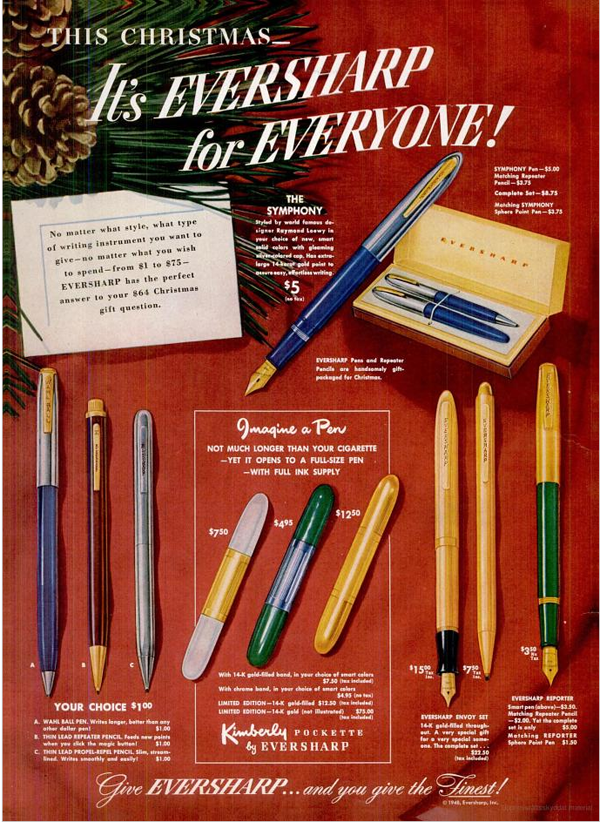
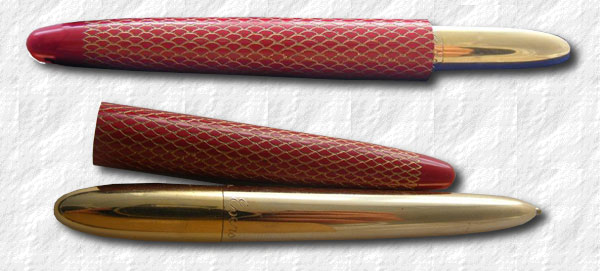
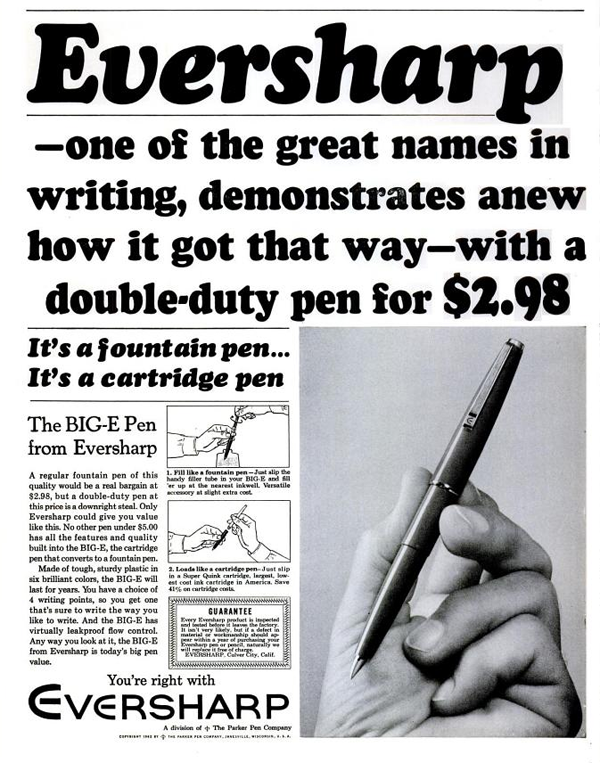
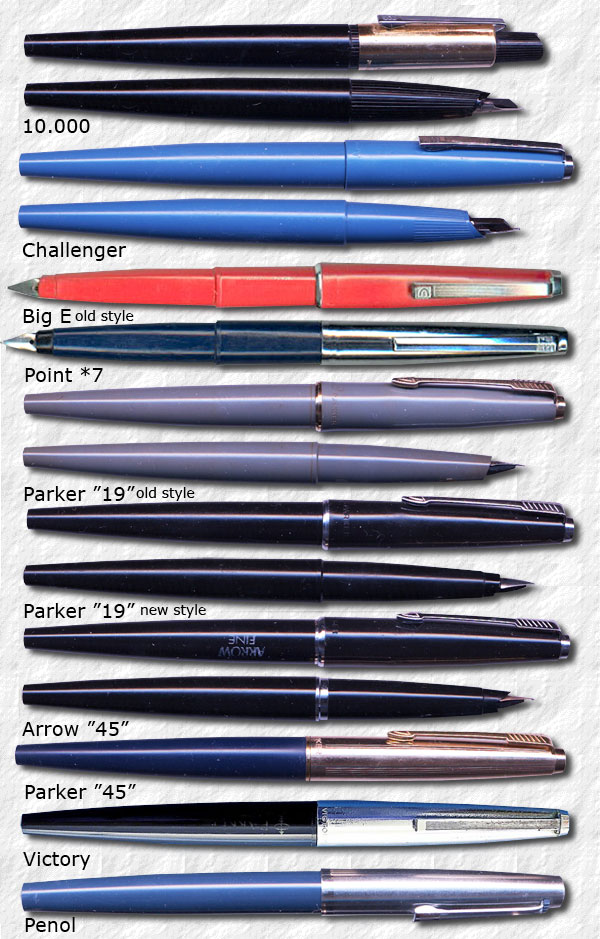
| he Parker Eversharp 10.000 pen was offered as a fountain pen, brawl pen and mechanical pencil. It had a somewhat strange cap that seems too brusk for the pen. The prune was very square with the Eversharp "East" engraved at the bottom and a v-shaped clip spiral, probable borrowed from the Eversharp Viking/Vanguard series, possibly made in the U.k. for the Nordic market in the late 1950's. It too had a strange "backwards" (though not removable) beak collar, protruding underneath the steel neb. The gripping section was striped. It was offered in the colours of Black, Reddish, Blue, Greyness, Green and white. The 10.000 pen was of course not really a Parker pen, since it was both developed and made by Eversharp in the Culver Urban center factory in California, but it was indeed an important stepping stone for the future business ventures past Parker. Parker as well continued production of the Kimberly Pockette ball pen, now re-named the Even though the Parker "45", introduced in 1960, was designed by Don Doman (who as well designed the Jotter, Parker 61, Parker VP, Parker 75, Parker T1 and Liquid Lead), he clearly based it on the "10 000". Parker now had the opportunity to test a range of economic system pens. In the summertime of 1961 the Eversharp |  nitially the nib/feed unit of measurement was not replaceable, the pecker collar was in one slice with the section and in the aforementioned colour. The prune was very like to the 10.000 pen, and strangly enough some ten.000 pens take been found wrapped in Big E boxes. The Big-E was priced at $ii.98. It was offered with four neb sizes, Extra fine, Fine, Medium and Broad and in the half-dozen colours of Black, Green, Nighttime Blue, Light Bluish, Blood-red and Grayness. It had a smooth gripping section and longer cap that was not interchangeable with the ten.000 pen. nitially the nib/feed unit of measurement was not replaceable, the pecker collar was in one slice with the section and in the aforementioned colour. The prune was very like to the 10.000 pen, and strangly enough some ten.000 pens take been found wrapped in Big E boxes. The Big-E was priced at $ii.98. It was offered with four neb sizes, Extra fine, Fine, Medium and Broad and in the half-dozen colours of Black, Green, Nighttime Blue, Light Bluish, Blood-red and Grayness. It had a smooth gripping section and longer cap that was not interchangeable with the ten.000 pen. Parker in Toronto, Canada launched a Big E version of their own in 1961, the Parker "19", with a "45"-style clip and a non-interchangeable bill/feed. As opposed to the Big Due east it was offered either with steel or gilt nibs and either with chrome trim or with gold electroplated trim and nib. It was offered in the colours of Black, Reddish, Dark Blueish, Light Blue, Light-green and Grey. Both the Parker "nineteen" and the Large E were refashioned in 1962 to incorporate a replaceable nib, like on the Parker "45". Although interchageable, the nib collar was a little dissimilar in design, the "45" collar covering more of the bill. The Big East was and then sold complete with a free cartridge and new converter, which ordinarily was a 49-cent item. Also in 1962 a cheaper cartridge pen with a plastic cap and body, chosen the |
| 1950 and 1951 ads, the Parker Eversharp Doric and the Envoy (paradigm courtesy of Jonathan Veley). |
| he Eversharp "10.000" was even so being offered in 1962, as was the Reporter brawl pen, only both were being phased out. It now sold with a special offer. If the purchasers returned 2 empty cartridges with a coupon on the back of the bill of fare-pack they received a refund of $one.00 on the $1.98 they paid for the pen. And, purchasers of an 88-cent Eversharp Reporter ballpen could pay a penny more and receive a 39-cent utility Eversharp. Parker Eversharp too offered the The In 1962 Parker introduced the $three.95 Parker "45" Pointer cartridge pen. The Pointer was aimed directly at the 22 million young people in loftier schoolhouse and college. The price of the Pointer, coupled with values similar a 14-karat replaceable betoken and cartridge convenience, was designed to attract them to Parker products. A smaller sized Lady "45" was also offered, a "smartly styled version of the Convertible pen". Ii models were offered; the golden Lady "45" with its cap screw and barrel tassy fashioned of an impregnated wood material, and the chrome Lady "45" with cap screw and tassy matching the grip expanse. |  nother sibling that used the Parker "45" feed and nib was the nother sibling that used the Parker "45" feed and nib was the  Varsity, a seldom seen pen marketed in 1963. They came in the colours of Blackness, Red, Charcoal, Blue, Beige and mayhap White. Varsity, a seldom seen pen marketed in 1963. They came in the colours of Blackness, Red, Charcoal, Blue, Beige and mayhap White. As the name suggests, they were aimed to be sold to students. They had a transparent plastic collar effectually the pinnacle of the section so that the pupil could personalise the pen by inserting a slice of newspaper with a name on information technology under the plastic. It had a very distinct clip, crocodile-style, and a gripping department with indentations for a meliorate grip. They didn't take the gold nibs of the Parker "45" and another difference was a stainless steel tassie ring. Items in the Parker athenaeum also suggests that the pens were sold either with stainless caps or plastic caps, Parker "45" Arrow style. The Varsity was also some 10 millimeters shorter and more "chubby" than the "45". Another uncommon "45" family fellow member was fabricated in Canada, probably effectually 1963, a By 1964 the ten.000 pen, the Challenger, the Parker "xix", Reporter, Gamin and the Big E had been phased out. Instead Parker Eversharp was offering the pen with the curious name, the |
| 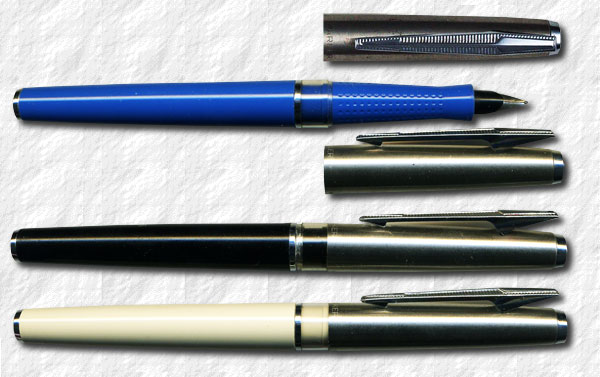 |
| 1953 and 1962 ad and the Parker Varsity (courtesy of Tsachi Mitsenmacher). |
 ther Eversharp products were the Deluxe ballpen and mechanical pencil, offered in the colours of Green, Black, Blue, White, Red and Greyness, and the Envoy ballpens and pencils with 12k gilded filled caps and barrels. The Diplomat was another pen and pencil gear up sold with an "Ever-chrome cap and barrel". Two styles of desk sets, the D-300 and D-305 was too offered in Black, Low-cal Blue, Green, Blood-red and Ivory. ther Eversharp products were the Deluxe ballpen and mechanical pencil, offered in the colours of Green, Black, Blue, White, Red and Greyness, and the Envoy ballpens and pencils with 12k gilded filled caps and barrels. The Diplomat was another pen and pencil gear up sold with an "Ever-chrome cap and barrel". Two styles of desk sets, the D-300 and D-305 was too offered in Black, Low-cal Blue, Green, Blood-red and Ivory. A Point *vii version with a plastic tip, the Around 1966 Parker Eversharp were picayune around with other desk-top producs, like the Eversharp arrow, a pen like tool that could be elongated into a rod, and the Time & worksaver ensemble, a turqoise-green box containing four handy mini-tools with bright orangish handles; a Clipit paper cutter, a Minifix with small-scale screwdriver, a Letteropener and a Handyknife. The tools had come up out from the Parker Special Products Division, which was organised in 1960, who by 1965 had come up up with some 119 unlike producs. The Clipit was launched already in August of 1961. The Drivit screwdriver, with three interchangeable blades, the Dew'information technology push-button moistener, the Sta-pul staple remover and the Redi-clip clip-dispenser, were amidst other things produced. |  ut business wasn't going very well for Parker, and the economy Eversharp pens were never able to really compete with the other companies making cheaper pens at this time. ut business wasn't going very well for Parker, and the economy Eversharp pens were never able to really compete with the other companies making cheaper pens at this time. George Parker, who was the president of Parker in the belatedly 1960'south explained: In 1968 Parker decided to shut the Eversharp sectionalisation downwards. Special thanks to David R Cress, Matt McColm, Antonios Zavaliangos, Lynn Sorgatz, Daniel A Zazove, Jim Mamoulides, Ricardo Thomson, Don Lamkin, Paul Barrell and Tsachi Mitsenmacher. |
| |
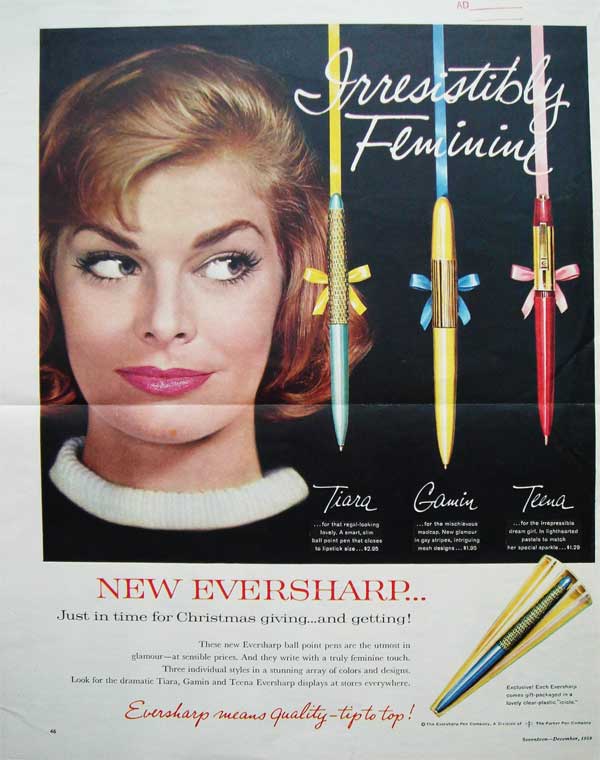
| A comparing of the "45"-family and a 1959 ad. |
| |
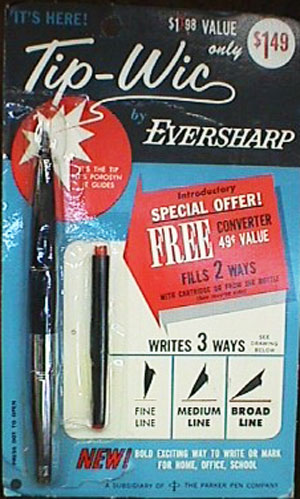
| The Tip-Wic Signal *7 |
© 1995-2019 Tony Fischier and The Parker Pen Visitor®/Sanford Ecriture.
This page is in no way sponsored by or created past the Parker Pen Company®. All opinions, views, and thoughts expressed herein are expressly the authors, and in no mode reverberate the opinions, views, or thoughts of the Parker Pen Visitor®/Sanford Ecriture. All logos and/or images on these pages are © Copyright of Parker Pen Company®Sanford Ecritureunless otherwise stated and is reprinted past kind permission. If Yous feel that Your copyright has been violated please contact the WEBMASTER.
Everything on this website is copyrighted past law and tin not exist used without written permission from the writer, Tony Fischier. Y'all may nonetheless use the information every bit reference cloth and although information technology is forbidden to make digital copies or reproductions it may exist physically printed for personal utilise, which does non include use on other web pages or in advertising. You may however quote parts of the content of this website, digitally or physically, providing that the source and writer is clearly stated, together with the copyright information. In the The states referred to every bit Fair use. If you utilize any information on this site, add a link.
Feel complimentary to donate a small sum through Paypal to help this site to stay online.Acknowledgements.
Parkercollector.com in translated versions

Source: https://parkerpens.net/parker-eversharp.html
0 Response to "Big Red Writes Again Ads Big Red Pen Advertisement"
Post a Comment